 |
|---|
|
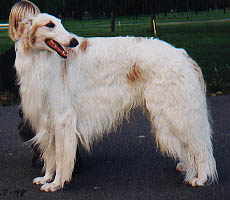
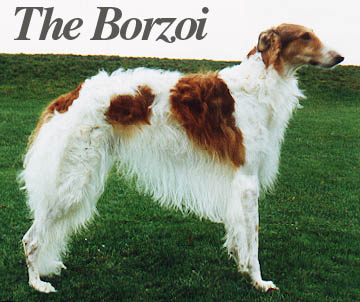
The dog above is Swedish owned "Sergei" (Kennel Velikij) taken at only 17 months, November 1998. See first pic. below for him as a mature male! What a difference! This breed is one of the largest Sighthounds yet at the same time it is surprisingly easy to keep as it is mostly "cool, calm and collected", (unless there is a hare in sight!) being quiet and so sweet and charming around the home, that it wins it's way into everyone's heart. In many ways, a "gentle giant!" |
|
| A little Borzoi history The Borzoi, in common with so many other sighthounds, was originally owned by noblemen and royalty only, but the abolition of serfdom in 1861 changed the social customs of the Russian people. All the sighthounds have a long history behind them, and the Borzoi is no exception. The first mention of a Russian hunting dog appears in the middle of the thirteenth century, although it's a reference to a hound that hunted hares rather than wolves, which were otherwise the common quarry of these dogs. Two types predominated. There was the shorter haired Borzoi which was tall, and pale coloured, beige and white or brindle and white. This was thought to be the most ancient variety and was probably nearer to the Greyhound than the other types. The other dominant breed was smaller, finer and rangier, usually dark in colour and possessing more stamina than the larger hounds. Early artistic records exist in hunting frescoes in Kiev's Sophia Cathedral, dating back to the 11th century. These paintings show hounds of the Borzoi type chasing boars and stags and it would seem that the curly coated Greyhound type must have existed long before the first written references. The dark or black coated dogs were long frowned upon by the Russian nobility because they stood out more clearly in the snow. With the liberation of the serfs came the closing of many of the large estates and their enormous kennels and the breed degenerated for a while. But in 1873 the Society for the Development of Hunting Dogs and Proper Conduct for Hunting was founded in Moscow. This society arranged dog shows and aimed to improve canine conformation as well as hunting abilities. In 1887 a supporter, Archduke Nicolai Nikolajawitsch, founded the now world-famous Perchino kennels, which he based on the very best bloodlines available at the time. He started with 60 Borzois and built a number of stone houses, each containing boxes for a dozen hounds. Every house had three paddocks and only the houses for the bitches and puppies were heated! The dogs had no heating at all the whole year round! The dogs were grouped where possible after their colours. About 50 puppies a year were reared. When embarking on a wolf hunt, the duke would take about 35 couples with him. The couples consisted in fact of three hounds - two dogs and a bitch - again selected mainly after their colours. About 40 riders would go ahead in the forest to be hunted, any spaces and gaps were covered with nets. Then a pack of foxhounds, also owned by the Perchino kennels would be sent ahead to flush out the quarry. The Borzois were restrained on very long leads by riders who galloped after the wolves, then slipped the Borzois who ran up alongside and harassed and bumped, often the third dog running and biting from behind until the wolf lost its balance and fell and whereupon it was immediately grabbed at the ears and throat and held down by the three dogs. The hunters then rode up and bound its legs and wedged a wooden block between its teeth. These wolf hunts lasted about an hour each and any young healthy wolves would then be released again. General appearance The first impression of a Borzoi is dominated by its impressive size, its thick and wavy coat, the elegance and beauty in its lines and harmony of build that all together create a very stunning looking dog. Size is from 70 to 82 cm or more at the shoulder, bitches are always 5 cm or more smaller. The largest known Borzoi was Russian and measured 92 cm at the shoulder. Borzois have a long and dense wavy coat and owners must be prepared to spend some time caring for this, especially in periods of moulting. All colours are allowed, often basically white with coloured areas going over to darker dogs even self black does occur. Male Borzois have a curve to their backs that is a special characteristic for the breed. Bitches are similar but the curve is not so well defined. They have deep chest and tucked up stomachs. An elegant long head - there are many varieties of head of which each was given a name by the nobles who kept and bred them in the past. They should have dark, intelligent and keen looking eyes, almond shaped with dark eye rims. Hind quarters should be broad and powerful with long thighs, well bent stifles and broad well let down hocks. The tail is long and heavily feathered. The Borzoi was introduced into Britain at the end of the 19th century by the Duchess of Newcastle, who imported the famous Perchino and his self black and tan brother Argos, who won a silver medal in Moscow in 1892. These days the Borzois in England, whilst still looking very much like the Russian dogs, are often looked down upon by Russians. This is mainly due to the inevitable inbreeding that has occurred since the introduction of the quarantine laws, (luckily now lifted) but also, to the Russians, the main criteria is still the dog's ability to hunt and not it's beauty! In Russia, they are very strict. Before a dog becomes a show champion, it must be 3 years old and have working certificates as well as three of the coverted gold medals. The Russian equivalent of our certificate consists of one beauty certificate and two working certificates! Hunting instinct |
As a family dog A Borzoi should have a firm but loving and understanding owner. They cannot tolerate much shouting and anger and persons with a "fiery" temperament had best not have a sighthound. Borzoi, as with some of the other sighthounds, become overly nervous, confused and very unhappy with a lot of harsh and angry treatment. |
My e-mail: janetfm@sighthound.net |